
The fragile peace in Southeast Asia was shattered today, December 8, 2025, as Thailand launched targeted airstrikes against Cambodian military positions. This dramatic escalation marks the most significant flare-up in the region since the brief but deadly clashes in July 2025. With casualties reported on both sides and thousands of civilians displaced, the renewed conflict threatens to destabilize the region and derail crucial economic negotiations regarding the Gulf of Thailand.
Breaking News: The December 8 Airstrikes
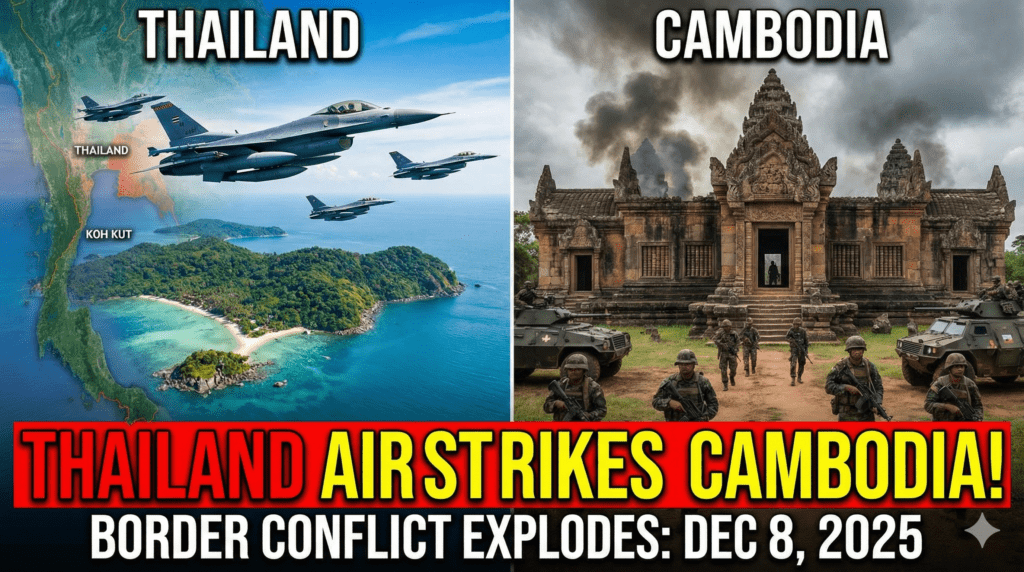
Early this morning, the Royal Thai Air Force executed airstrikes in the An Ses area near the Preah Vihear province. According to Thai Army spokesperson Maj. Gen. Winthai Suvaree, the strikes were a retaliatory measure following a Cambodian attack that resulted in the death of one Thai soldier and injuries to four others.
“We did not want to see violence, but the military was ready to take necessary measures to maintain security and the sovereignty of the country,” stated Thai Prime Minister Anutin Charnvirakul.
Conversely, Cambodia’s Defense Ministry has vehemently denied initiating the hostilities. Spokesperson Maly Socheata accused Thai forces of unprovoked aggression, reporting that the airstrikes killed four Cambodian civilians and destroyed homes. This “he-said-she-said” narrative has characterized the conflict for decades, but the introduction of air power marks a dangerous new phase in the Thailand-Cambodia border conflict.
Context: A History of Volatility
To understand today’s violence, one must look back at the events of mid-2025. In July, a five-day combat broke out near the Ta Muen Thom temple, resulting in dozens of deaths. A US-brokered ceasefire brought a temporary halt to the fighting, but tensions have simmered beneath the surface.
The core of the dispute is not just about a line on a map; it is a complex mix of historical nationalism, colonial legacies, and modern economic needs.
1. The Preah Vihear Temple Dispute
At the heart of the land dispute lies the ancient Hindu temple of Preah Vihear. While the International Court of Justice (ICJ) ruled in 1962 (and reaffirmed in 2013) that the temple belongs to Cambodia, the 4.6 square kilometers of scrubland surrounding it remains a flashpoint. Thai nationalists have long argued that the demarcation—based on a 1907 French colonial map—unfairly disadvantages Thailand. Today’s airstrikes near this region suggest that the wounds of the past have yet to heal.
2. The Maritime Dispute: Koh Kut and MOU 44
While the land border grabs headlines, the maritime dispute is perhaps more consequential for the future. Both nations claim overlapping waters in the Gulf of Thailand, an area believed to be rich in oil and natural gas deposits.
- Koh Kut (Koh Kood): This resort island is undeniably Thai territory, but its location is used to define maritime baselines. Cambodian maps have historically drawn lines that cut through the island’s vicinity, alarming Thai sovereignty advocates.
- MOU 44: The 2001 Memorandum of Understanding (MOU 44) was a framework designed to allow both countries to negotiate the maritime border while jointly developing the energy resources. However, political pressure in Thailand has mounted to scrap MOU 44, with critics arguing it risks ceding territory to Cambodia.
The failure to progress on these energy talks has added economic frustration to the nationalist fire. With energy prices rising globally, both Bangkok and Phnom Penh are desperate to unlock the resources in the Gulf, but neither can afford to look “weak” on sovereignty.
Military Balance: A David vs. Goliath Scenario?
Analysts are closely watching the military dynamics. Thailand, a US treaty ally, possesses a significantly more advanced military.
- Thailand: Boasts a modern air force with F-16 and Gripen fighter jets (used in today’s strikes) and a large standing army.
- Cambodia: While smaller, Cambodia’s military has been modernized with assistance from China and possesses battle-hardened ground troops and artillery units capable of inflicting damage on border towns.
The disparity in air power was evident today, but Cambodia’s strategic artillery positions along the Dangrek Mountains mean that any ground war would likely be bloody and protracted for both sides.
Global and Regional Implications
The renewed Thailand-Cambodia conflict is a nightmare for ASEAN (Association of Southeast Asian Nations). The bloc prides itself on non-interference and peaceful conflict resolution. Heavy fighting between two member states undermines ASEAN’s credibility and unity.
Furthermore, external powers are watching. The US, having brokered the previous ceasefire, will likely pressure Bangkok to de-escalate. meanwhile, China, having close ties with Cambodia, will be keen to prevent instability in its backyard.
Conclusion: What Comes Next?
As night falls on December 8, the situation remains fluid. The immediate priority is a cessation of airstrikes and a return to the negotiating table. However, without addressing the root causes—the demarcation of the Preah Vihear surroundings and the sharing of maritime resources under a revised or enforced MOU 44—peace will remain elusive.

For investors and travelers, the border regions are currently “no-go” zones. The world waits to see if diplomacy can prevail before this border skirmish spirals into a full-scale war.
jiliko – Jiliko Online Casino Philippines: Secure Jiliko Login, Register, App Download & Best Slots. Experience Jiliko Online Casino Philippines! Enjoy secure Jiliko login, fast Jiliko register, and top Jiliko slots. Jiliko app download now for the best PH gaming. visit: jiliko
bbjl https://www.wbbjl.org
Max wins, baby! If you’re chasing that jackpot, might wanna check out maxwinprimogaming. Sana all manalo ng malaki!
Alright lads, anyone checked out 32win21? Had a little win on the roulette! Easy site to use, and I liked that I could quickly withdraw. Definitely recommend giving it a try if you fancy a flutter.
Alright, x666gameapk, let’s see what you’ve got! Always on the hunt for the latest game APKs. Hopefully they’re bug-free. Grab yours x666gameapk
Been playing on ta28bet for a while now and honestly, it’s pretty solid. The games are legit, and I’ve had some decent luck. Definitely worth checking out if you’re looking for a new place to gamble online. Click here: ta28bet
Looking for some 639club slot action? This site has got you covered. Variety of games and decent payouts. Definitely worth a spin! You can access it here: 639clubslot