
In the age of hypersonic weapons and space-based surveillance, air defense is no longer just about stopping fighter jets—it’s about controlling the skies, near space, and the future battlefield. One system that has drawn intense global attention is the S-500 missile defense system developed by Russia. Often described as a next-generation shield against advanced aerial threats, the S-500 is being positioned as a direct challenger to U.S. missile defense dominance.
But what exactly is the S-500, how powerful is it, and should the United States be concerned? Let’s break it down.
What Is the S-500 Missile Defense System?
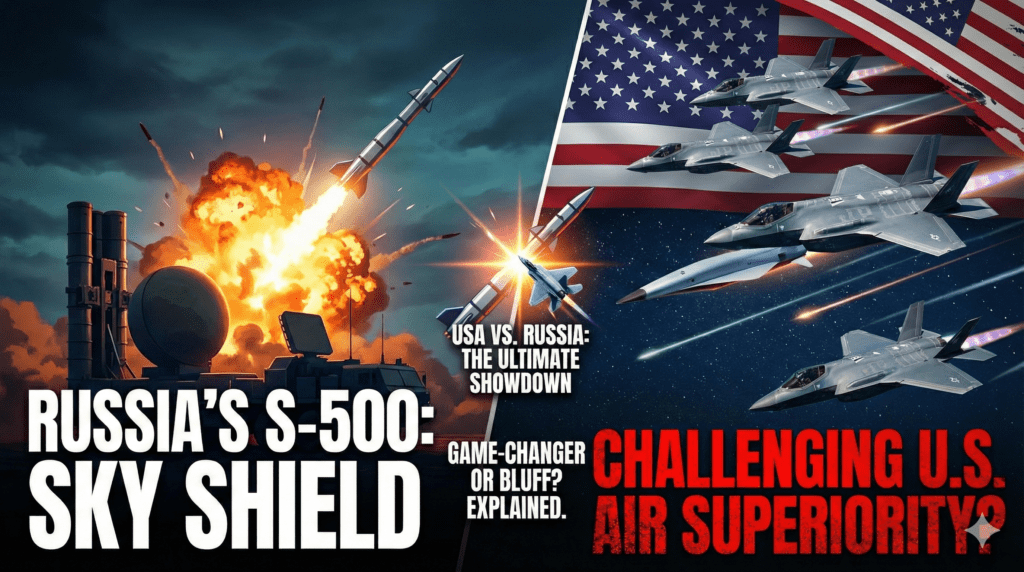
The S-500, also known as “Prometey,” is Russia’s most advanced surface-to-air and missile defense system. Unlike traditional air defense platforms, the S-500 is designed to intercept:
- Hypersonic missiles
- Intercontinental ballistic missiles (ICBMs)
- Stealth aircraft
- Low-Earth-orbit satellites
This makes the S-500 more than just an air defense system it is a combined air, missile, and near-space defense platform.
Russia claims the S-500 can detect and destroy targets at ranges of up to 600 kilometers (about 370 miles) and intercept targets flying at extreme hypersonic speeds. If accurate, this would represent a major leap in defensive warfare technology.
How Is the S-500 Different from the S-400?
The S-500 is often compared to its predecessor, the S-400, which is already widely deployed and exported. While the S-400 is optimized for aircraft, drones, and cruise missiles, the S-500 expands the mission into strategic missile defense and space warfare.
Key upgrades include:
- Much higher interception altitude
- Faster radar tracking
- Capability to target space objects and ballistic missiles
- Improved resistance to electronic warfare
From a military engineering standpoint, the S-500 is built to counter the newest generation of U.S. weapons, including stealth bombers and hypersonic glide vehicles.
Why the S-500 Matters to the United States
For the United States, the S-500 represents a shift in the global air defense balance. American air doctrine has long relied on air superiority achieved through stealth aircraft like the B-2 and F-35, along with long-range missile strikes. A mature S-500 network could potentially:
- Reduce the effectiveness of stealth penetration
- Increase the risk to long-range bombers
- Challenge satellite-based surveillance and communications
This is especially significant in potential conflict zones involving NATO allies, where layered Russian air defenses could restrict U.S. air operations.
Is the S-500 Operational or Still Experimental?
Russia announced the S-500 as operational in limited numbers, primarily around Moscow and other strategic sites. However, outside analysts remain cautious. Large-scale deployment takes years, and real-world performance under combat conditions is still unknown.
Military systems often perform differently outside testing environments. Radar clutter, electronic jamming, decoys, and swarm attacks all complicate interception. Until the S-500 is tested in sustained conflict, much of its reputation remains theoretical rather than proven.
How Does the U.S. Compare?
The United States operates a multi-layer missile defense architecture that includes:
- Ground-Based Interceptors (GBI)
- THAAD (Terminal High Altitude Area Defense)
- Aegis Ballistic Missile Defense
Unlike the S-500, the U.S. approach emphasizes global radar coverage, naval-based interceptors, and early space detection rather than relying on a single ultra-powerful system.
In other words, Russia is focusing on a high-performance “shield”, while the U.S. emphasizes a distributed defense network.
Strategic Implications for Global Security
The rise of the S-500 adds pressure to an already volatile strategic environment. As both the U.S. and Russia invest heavily in hypersonic weapons, advanced sensors, and space warfare, air defense systems like the S-500 become central to future deterrence.
For NATO planners, the S-500 complicates air operations near Russian airspace. For Washington, it reinforces the urgency of developing next-generation stealth, electronic warfare, and counter-defense technologies.
This is no longer just a race for faster missiles—it is a contest over who controls the entire vertical battlespace, from ground level to outer space.
Final Verdict: Game-Changer or Strategic Bluff?
The S-500 missile defense system is undoubtedly one of the most ambitious air defense projects in the world today. On paper, its capabilities suggest a serious challenge to Western air power. In reality, its long-term impact will depend on:

- Production scale
- Operator training
- Integration with radar and satellite systems
- Performance in real combat environments
For now, the S-500 stands as a powerful symbol of Russia’s attempt to reshape the future of air and missile defense. Whether it becomes a true game-changer or remains a strategic deterrence tool is a question only time and conflict can answer.
Если основной сайт недоступен используй куш казино зеркало. Все бонусы и аккаунт сохраняются. Вход выполняется быстро. Продолжай игру без ограничений – куш казино официальный сайт
https://dogs-academia.ru/
заказать диплом
https://dogs-academia.ru/
диплом заказать
дизайн комнат коттеджей дизайн проект коттеджа